
Groin Pain in Athletes: Causes, Diagnosis and Treatment
You get told it’s a groin strain. You rest it. It feels better. You get back into training, maybe even play a game or two. Then, right around the two-week mark, it’s back, sometimes worse than before.
If that cycle sounds familiar, here’s the thing nobody usually tells you: “groin strain” isn’t a diagnosis. It’s a location. The groin is where several different structures overlap (muscles, tendons, the hip joint itself, even the abdominal wall) and at least five distinct problems can turn up as pain in that same patch of real estate. Rest doesn’t fail because you didn’t rest enough. It fails because nobody worked out which of those five problems you actually have.
This article walks through the main possibilities, why the label matters more than most people realise, and what it actually takes to get groin pain to stay away for good.
What causes groin pain in footballers (and runners, and gym-goers)?
Kicking sports load the groin in ways few other activities do — repeated hip extension and rotation, sudden changes of direction, forceful hip flexion to strike the ball. Runners load it differently again, with high-volume, repetitive hip flexion and extension. Both can produce groin pain, but through quite different mechanisms, which is part of why one generic “groin strain” label doesn’t serve either group well.
Broadly, the pain you’re feeling can be coming from one (or more) of five areas.
Adductor-related pain — the true “strain” territory
This is what most people picture when they hear “groin strain.” The adductor muscles run down the inner thigh and attach via a tendon near the pubic bone. In kicking and change-of-direction sports, this tendon takes a hammering.
Tell-tale signs: pain when you squeeze your knees together against resistance, and pain kicking the ball across your body. This is genuinely the most common source of groin pain in kicking sports, which is exactly why it gets assumed every time, even when it isn’t the culprit.
Hip flexor-related pain
The muscles at the front of the hip that lift your knee and drive your leg through when you sprint or kick can also become overloaded and painful. This tends to show up in sprint-heavy sports and is often confused with adductor pain because the two sit close together and can both ache with running.
Abdominal-wall-related pain (sometimes called the “sports hernia”)
Where the lower abdominal muscles attach near the pubic bone, overload can cause pain with sit-ups, coughing, sneezing, or sudden changes of direction. You’ll sometimes hear this called a “sports hernia” or “athletic groin pain”, confusing terms, because in most cases this isn’t a true hernia at all. It’s an overloaded muscle attachment, not a hole in the abdominal wall.
That said, a genuine hernia does need to be ruled out, particularly if there’s a visible bulge, or the pain changes with straining or lifting. This is one of the misses that matters. If a true hernia is missed and treated as a muscle strain, it won’t resolve with rehab, and it may need a surgical opinion.
The hip joint itself
This is the big one that gets missed. Problems inside the hip joint (femoroacetabular impingement (FAI) or labral tears) can refer pain straight into the groin. It often feels like a deep ache rather than a surface strain, with pinching in deep hip flexion: squatting low, getting in and out of a car, tying your shoelaces. Sometimes there’s clicking or catching as well.
Here’s why this one matters so much: if you rehab a hip joint problem as though it’s an adductor strain, you’ll spend months strengthening a muscle that was never the issue, while the joint itself keeps getting aggravated. This is very likely why so many people describe groin pain as “permanent” — not because it can’t be fixed, but because it was never assessed properly in the first place.
Referred pain and everything else
Sometimes groin pain isn’t coming from the groin at all. The lower back can refer pain into this area, and certain nerves can become irritated and produce groin symptoms with no local muscle or joint problem present.
There’s also one possibility that’s rare but genuinely urgent: a stress fracture in the hip or pubic bone, seen occasionally in high-load runners. The red flag here is pain that’s present at night, or that keeps getting worse despite rest, that pattern deserves prompt review rather than a wait-and-see approach.
Why the diagnosis changes everything
This is the part that actually matters for getting better, so it’s worth being blunt about it.
- Adductor problems respond to progressive adductor loading.
- Hip joint problems need load modification and hip-specific strengthening – loading the adductors hard can actually aggravate them.
- Abdominal wall problems need graded trunk loading, built up in stages.
- A true hernia needs a surgical opinion, not a rehab program at all.
Rest, on its own, doesn’t fix any of these long-term, it just takes the pain away temporarily while the underlying problem sits there unresolved.
Strengthening the wrong structure doesn’t just waste time; in some cases it can aggravate the actual source of the pain. The assessment isn’t a formality before the real treatment starts. The assessment *is* the treatment plan — everything that follows depends on getting it right.
When should I get groin pain assessed?
If groin pain has come back more than once, hasn’t settled with a couple of weeks of relative rest, or you’re getting deep pinching pain in positions like squatting or getting out of a car, it’s worth getting it properly assessed rather than guessing again. The same goes for any pain that changes with straining, coughing, or lifting, or pain that’s worse at night, these deserve a proper look sooner rather than later.
We won’t pretend you can nail this down from an article. Five different structures can produce overlapping symptoms, and telling them apart reliably takes a hands-on assessment, not a checklist. What we can do is demystify what that assessment actually looks like, so it feels less like a mystery and more like a process.
What groin injury assessment involves
Subjective Assessment
- History — exactly where the pain is, when it started, what movements bring it on and what makes it worse.
Objective Assessment
- Palpation and squeeze tests — checking the adductor tendon, abdominal wall attachment, and surrounding structures for tenderness and pain reproduction.
- Hip joint testing — specific movements to check whether the joint itself is contributing, particularly deep flexion and rotation.
- Strength measures — comparing both sides to spot deficits that point toward a particular structure.
Imaging (ultrasound, MRI, or X-ray) isn’t needed for every groin injury — plenty of straightforward adductor strains don’t require it. It earns its place when there’s suspicion of joint pathology, a possible stress fracture, or a true hernia.
How long does a groin injury take to heal?
This depends entirely on which of the five problems you’re dealing with, but it’s easiest to see the shape of a rehab pathway by walking through one example: adductor-related pain, since it’s the most common.
A typical pathway looks something like:
1. Settle the pain — isometric adductor squeezes (holding tension without movement) to calm symptoms early on.
2. Build strength — progressive adductor and trunk strengthening, gradually increasing load.
3. Reintroduce movement — running first, then change-of-direction work, then kicking.
4. Criteria-based return — rather than a fixed date, return to sport is guided by hitting specific strength and movement benchmarks. Our return-to-sport article covers what that looks like in practice.
The same staged logic applies to the other diagnoses — it’s just the specific exercises and loading targets that change. As for timelines: a recent-onset strain can settle in a matter of weeks with the right program. Long-standing groin pain that’s been mismanaged or misdiagnosed for a while often takes two to four months to properly resolve. We’d rather tell you that honestly upfront than have you drop out of a program at week three wondering why it isn’t fixed yet.
What exercises fix groin pain?
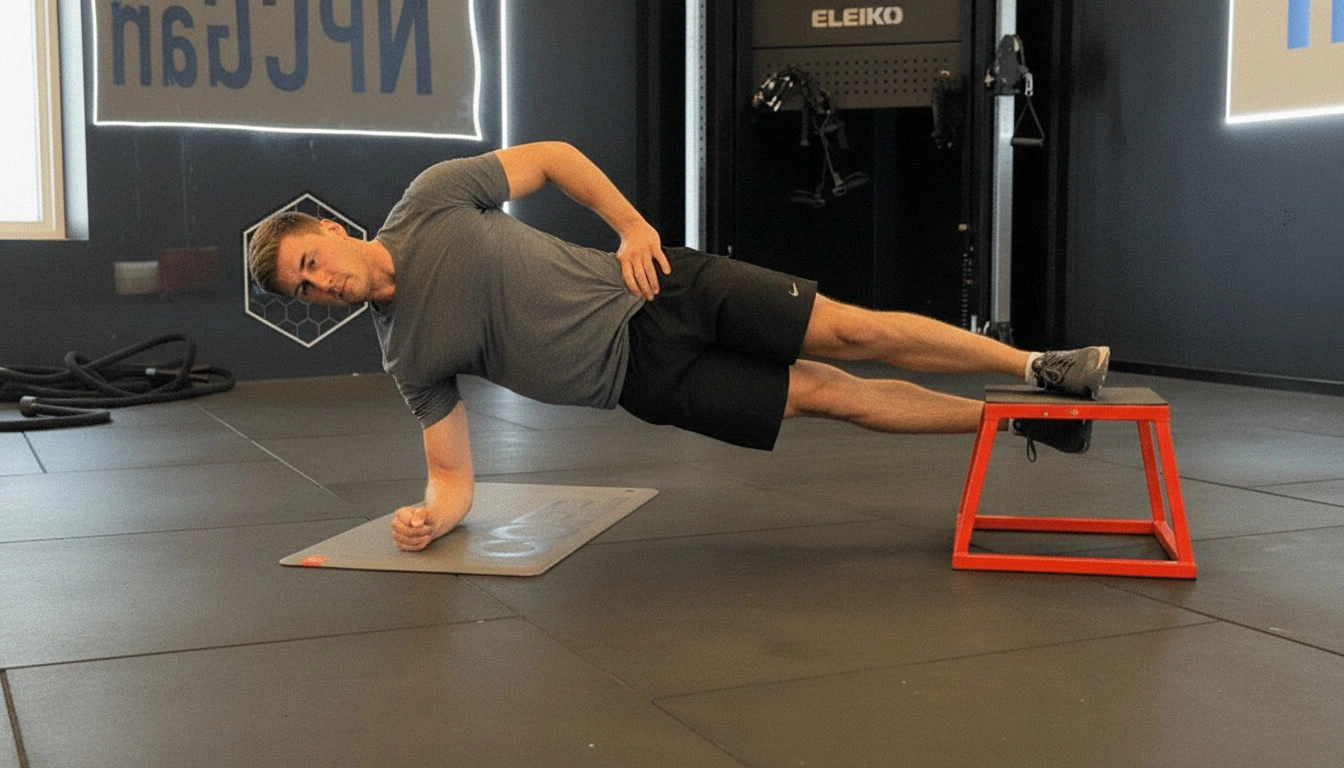
For adductor-related groin pain specifically, adductor strengthening programs (Copenhagen-style exercises being the best-known example) have been shown to meaningfully reduce groin injury rates in team-sport athletes, particularly when done consistently through preseason. A simple starting point is the Copenhagen plank progression, built up gradually over several weeks with attention to volume and technique rather than rushing the load.
The important caveat: this is the right prescription *if* your pain is adductor-related. The same exercise could aggravate a hip joint problem. This is exactly why exercise lists floating around the internet only get you so far because they assume everyone’s groin pain comes from the same place.
How VIBE handles groin pain
We start with a structured differential assessment, working through the possibilities above properly, rather than defaulting to “groin strain” and hoping rest does the job. From there, you get a program matched to what’s actually going on: targeted loading, gym-based strength work, and criteria-based return-to-sport testing before you’re cleared for full training and competition.
Where something falls outside physiotherapy’s scope such as a suspected true hernia, or hip joint pathology that needs imaging or a specialist opinion, we’ll refer you on promptly rather than keep persisting with rehab that isn’t going to work.
You can read more on our [hip, groin and thigh page, and if you’re dealing with hamstring issues alongside your groin pain (common in kicking sports) our hamstring article covers that ground too.
The bottom line
If your groin has “strained” more than once this season, the pattern itself is the clue. Repeated re-injury after rest almost always means the original diagnosis was incomplete. Stop guessing, get it properly assessed, and get a plan built around the actual problem rather than its postcode.
Book an appointment at either of our clinics, or visit our physiotherapy page to find out more about how we approach injuries like this.