
Return to Sport
The most common return to sport mistake
Here is the sentence that puts more athletes back on the physio table than almost anything else: “It’s been X weeks, my surgeon said I can play, so I’m playing.”
Time matters. It is one of the inputs. Tissue does heal on a rough timeline, but you cannot rush biology. However, the calendar only tells you how long it has been. It tells you nothing about whether your body can actually do the thing you are about to ask of it.
Healing and capacity are two different things. A graft, a muscle or a tendon might be structurally sound at the expected mark, while your ability to load it, sprint on it, cut off it, jump on it and react with it is nowhere near ready. Those qualities do not come back just because months have passed. They come back because you trained them back. Skip that part and rely on the date alone, and you are guessing. The re-injury statistics show how often that guess goes wrong.
This article is about the alternative: deciding you are ready based on what you can demonstrate, not on what the calendar says. We call it criteria, not calendar, and it runs through everything we do.
Time based vs criteria based: what’s the difference?
The difference is simple, but it changes everything.
Time-based clearance says: “You are nine months post-op, so you can play.” The date is the deciding factor.
Criteria-based clearance says: “You can play when you can show the strength, the movement quality and the sport-specific capacity the game demands, whatever week that happens to be.” The performance is the deciding factor.
The date still matters under the second approach, because some tissue genuinely needs a minimum amount of time and you should never go before it. The point is that time is the floor, not the green light. Hitting the date gets you to the start line of testing. Passing the tests is what gets you onto the field.
This is not a small distinction. Returning to sport on the calendar alone is linked with meaningfully higher re-injury rates than returning once you have passed a proper battery of tests, and the gap is starkest for serious injuries like ACL reconstructions. We will get to the actual numbers later, because they are striking.
One thing worth saying plainly, because it can read like criticism and it is not: if your surgeon, GP or physio gave you a time-based estimate, they were not wrong to. A rough timeframe is genuinely useful for planning, and most clinicians offer it as a guide rather than a guarantee. The problem is not the estimate. The problem is treating the estimate as the finish line.
The criteria that matter (and how we test them)
So if not the calendar, then what? Here is what we are actually measuring before we are happy to clear someone. None of it is exotic. It is just done properly and measured, rather than eyeballed.
Strength symmetry
The first question is whether your injured side has caught back up to your good side.
After a knee injury, we want quadriceps strength on the injured leg to be within about 90% of the other leg, and ideally higher. After an Achilles injury, we are looking at calf strength. After a hamstring strain, hamstring strength. The injured side almost always lags, usually by more than people expect, and you cannot feel a 30% strength deficit by walking around. It feels fine. It tests badly.
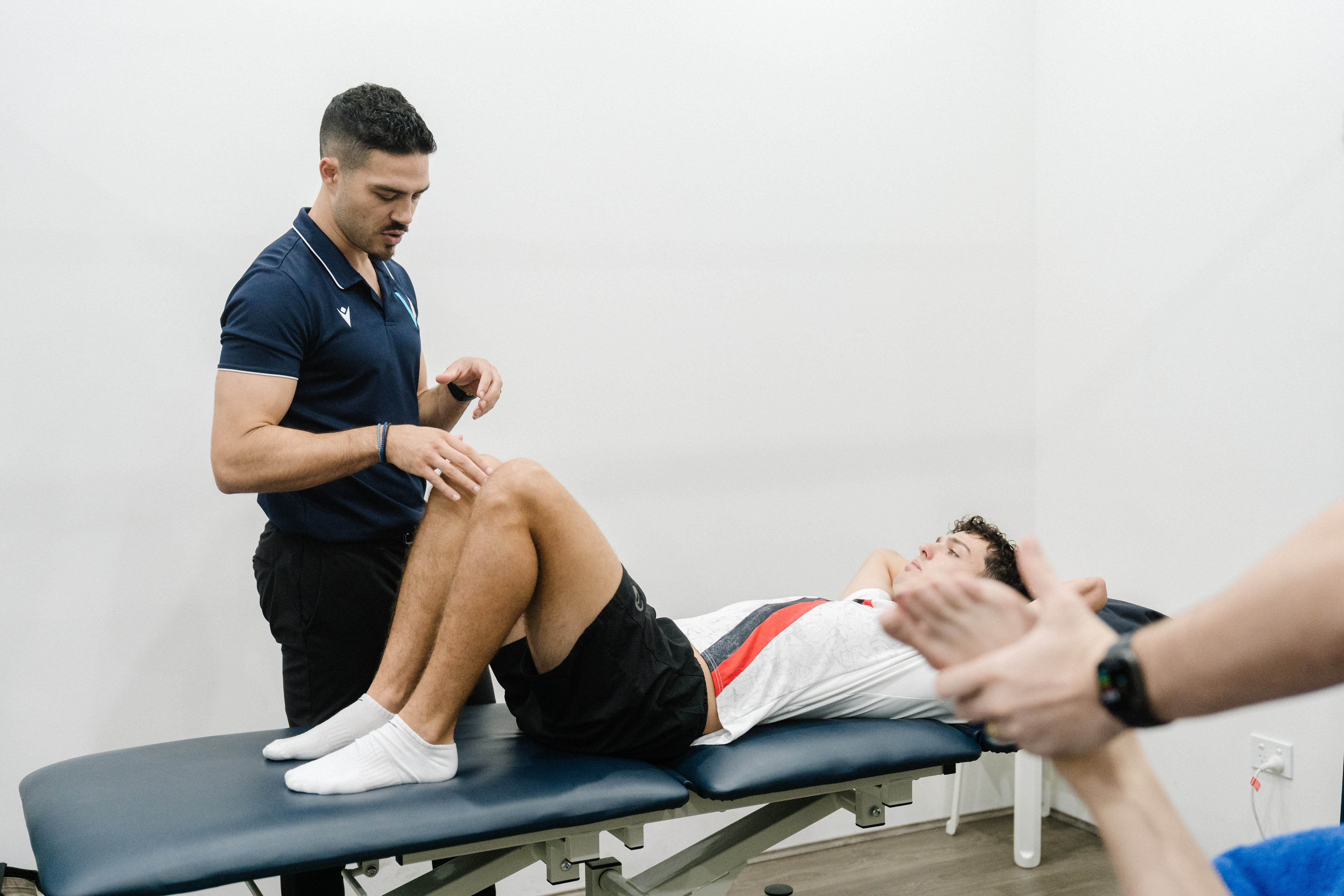
So we measure it rather than guess. Depending on what we are assessing, that means handheld dynamometry, isokinetic testing, or a loaded single-leg press, giving us an actual number for each side and a percentage difference between them. A number you can retest is the whole point. “Feels strong” is not a measurement.
Hop and jump testing
Strength on a machine is one thing. Producing and absorbing force explosively on one leg is another, and that is much closer to sport.
So we use hop and jump tests: a single-leg hop for distance, a triple hop, a vertical jump. We compare the injured side to the other side and look for symmetry, usually around that same 90% mark. But symmetry alone can fool you. If both legs have weakened over a long rehab, they can match each other while both sit below where you used to be. So we also compare against your pre-injury baseline where we have it. The goal is symmetrical and back to your own normal, not just even.
Movement quality
Numbers tell us what you can produce. Movement quality tells us how you produce it, and that is where a lot of re-injuries are hiding.
We watch how you land, cut and change direction. Does your knee collapse inwards when you land? Does your hip drop on a single-leg squat? Can you decelerate under control, or do you fall apart at the last second? Sometimes we film it, because the moments that matter happen too fast to judge by eye. The key is that we look at this under load and at speed, not just in slow, tidy reps. Plenty of people look perfect doing a controlled exercise and lose all of it the moment things get fast and fatiguing, which is exactly when injuries happen.
Sport-specific capacity
This is the bridge from the clinic to the actual game, and it is the bit most people skip.
Can you get through a full training session, at real intensity, with no symptoms during or after? Have you done your sport’s specific demands under fatigue, not just when fresh? For a runner that means the actual running load. For a team-sport athlete it means cutting, accelerating and decelerating repeatedly when tired. For contact sports it means you have done contact and your body coped. If you have only ever tested yourself fresh and in straight lines, you have not tested the thing that breaks down in a game.
Psychological readiness
This one gets overlooked, and it shouldn’t, because fear of re-injury is one of the better predictors of actually being re-injured.
We use validated questionnaires here, like the ACL-RSI scale for knee patients and similar tools for other injuries, because “are you confident?” deserves a real answer rather than a brave nod. An athlete who is hesitant, who is protecting the limb, who does not trust it to plant and go, moves differently and exposes themselves to the very injury they fear. If your body has passed everything but your head is not there yet, you are not ready, and that is not a weakness. It is information, and it is trainable like everything else.
What return-to-running progression actually looks like
Let’s make this concrete, because “criteria-based” can sound abstract until you see it in practice. Return-to-running is the clearest example, and it applies well beyond the knee: calf strains, Achilles problems, bone stress injuries, plenty of things.
You do not go from rehab to a 5k. You build in stages, and you only move up a stage once the one below it is comfortable, both during the run and the next day.
A typical progression starts by building tolerance to walking, then introduces run-walk intervals: short bouts of easy jogging with walking in between, repeated for a set total. As that becomes comfortable with no next-day reaction, the running portions get longer and the walking portions shrink, until you are running continuously at an easy pace. Only once you can hold continuous easy running do you start adding the harder stuff: more distance first, then faster pace, then hills or intervals. Distance before speed, always.
The rule underneath all of it: you progress on how the tissue responds, not on how impatient you feel. A flare-up the next morning is the signal to hold at the current stage, not to push through it. That is criteria-based thinking at the smallest scale. Each step has a box to tick before the next one opens.
What return-to-cutting/jumping/contact looks like
Team sports need the same staged logic, just with more moving parts.
The progression runs from controlled to chaotic. You start with solo drills: planned changes of direction, jumping and landing, your own movements at your own pace. Then partner drills, where someone else adds a bit of unpredictability. Then full team training. Then a modified or restricted game. Then, finally, full competitive match play. For contact sports, contact is layered in progressively along the way rather than all at once on game day.
Every stage has criteria to meet before you move to the next one: no symptoms, good movement quality, and the capacity to repeat it when tired. If a stage produces swelling, pain or sloppy mechanics, you stay there until it doesn’t. This is exactly how our clinicians manage return-to-play with the NPL football and netball teams we work with, week in and week out. Progressive exposure, with each step earned rather than assumed.
Why this approach reduces re-injury
Now the numbers, because they make the case better than any amount of persuasion.
The clearest evidence comes from ACL research, where this has been studied most. Athletes who pass a proper battery of return-to-sport criteria before going back have re-injury rates in the order of 5 to 10%. Athletes who return without passing those criteria are around four times more likely to re-tear. Same surgery, same rehab time, very different outcome, and the thing separating the two groups is whether they were tested and passed before going back.
There is also good evidence that going back too early, on time alone, carries a higher re-injury risk that falls as you both delay to an appropriate point and demonstrate readiness. The headline is consistent across the research: passing objective criteria before return is one of the strongest things within your control for staying on the field.
And the principle holds beyond the knee, even where the numbers are less dramatic. An athlete who comes back from a hamstring or calf strain having actually restored their strength and capacity re-injures far less often than one who returns the moment the pain settles. Pain going away is the start of the final phase of rehab, not the end of it.
Why a lot of clinics don’t do this
If criteria-based testing is so much better, why isn’t it everywhere? Honestly, for a few unglamorous reasons.
It takes time and equipment. Measuring strength properly, running hop batteries and screening movement is slower and more involved than saying “you should be right at six months”, and it needs kit that not every clinic has.
There is time and funding pressure. Insurance schemes and busy caseloads nudge everyone towards efficient, time-based milestones rather than repeated objective testing.
And very often the patient simply drops off. People come to physio to get out of pain, and once the pain is gone they stop coming, usually right when the hard, sport-specific, re-injury-prevention work is about to begin. Most people skip the final 20% of their rehab. That last 20% is precisely the part that keeps you on the field. It is no coincidence that it is also the least comfortable and least convenient part.
We are not saying this to knock other clinicians, most of whom are doing their best inside real constraints. We are saying it because you should know that “your pain is gone, you’re probably fine” is the moment to lean in, not to disappear.
How VIBE handles return-to-sport
Our whole model is built around finishing that last 20% properly.
When you reach this stage with us, you get actual testing rather than a gut feel. We measure strength side-to-side with the right equipment, run you through hop and jump batteries, and screen your movement under load. Then the physio and exercise physiologist work together on the sport-specific phase: rebuilding your capacity for the exact demands of your sport, under fatigue, in the patterns the game actually uses. Where it helps, we coordinate with your coach so that what happens at training lines up with where your rehab actually is, rather than the two pulling against each other.
The question we are answering is not “when can you play?” It is “when can you play and stay played?” Those are very different questions, and only the second one keeps you off our table next season.
If you’re approaching return-to-sport, what to do now
If you are getting close to coming back, the single most useful thing you can do is get tested before you test yourself in a game. Do not wait until you feel ready and then just try a match to see what happens. Feeling ready and being ready are not the same thing, and a game is the worst possible place to find out which one you are.
Book a return-to-sport assessment. Get the objective picture: where your strength, movement and capacity actually sit, what is left to close out, and how long that realistically takes. Then go back with a clear pass rather than a hopeful guess.
Wrap-up
Time is one input, not the verdict. The calendar tells you how long it has been. Testing tells you whether you are ready, and only one of those keeps you on the field.
If you are coming back from injury, book a return-to-sport assessment at either clinic. Don’t skip the final 20% of your rehab. It is the least convenient part, and it is the exact part that keeps you playing. Criteria, not calendar.