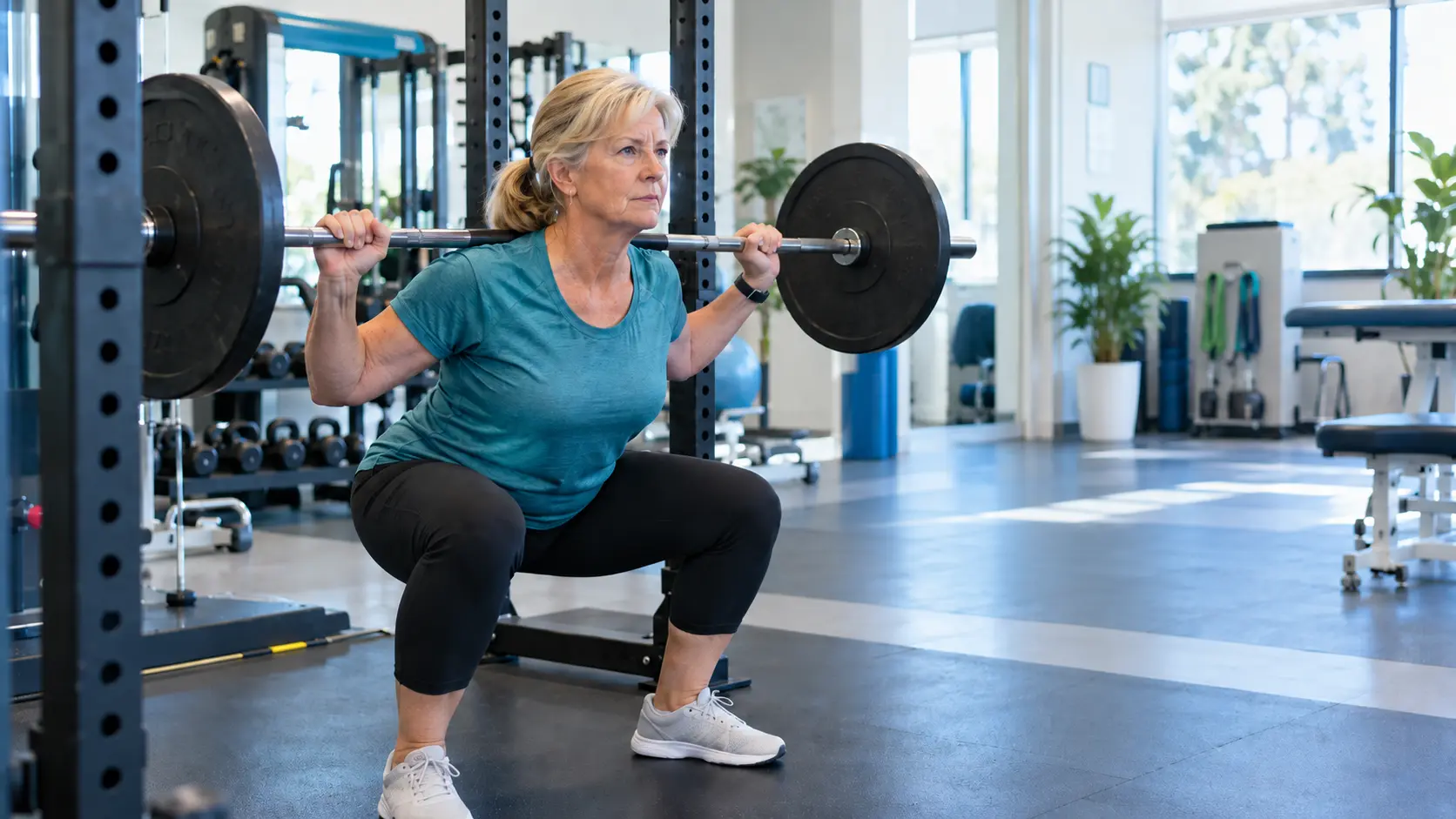
The best exercise for osteoporosis isn’t walking. It’s a combination of progressive resistance training, appropriately scaled impact loading and challenging balance work. Walking alone doesn’t give your bones enough of a stimulus to get stronger.
Being told you have osteoporosis or osteopenia can change the way you think about your body almost overnight.
You may have been gardening, travelling, carrying the shopping and exercising normally. Then a bone density scan comes back with a low T-score and suddenly ordinary activities can feel risky.
Should I still lift weights?
Can I bend over?
What happens if I fall?
Wouldn’t it be safer to stick to walking?
That concern is understandable, but becoming less active can create its own problems.
Less activity can mean less muscle strength, poorer balance and further loss of physical capacity all of which can make falls and fractures more likely.
Your bones are living tissue, and they respond to the loads you place on them.
Exercise is therefore an important part of osteoporosis management. But not every type of exercise has the same effect on bone.
Australian guidance from Exercise & Sports Science Australia (ESSA) and Healthy Bones Australia supports a combination of progressive resistance training, appropriately prescribed weight-bearing impact exercise and challenging balance training. For people already diagnosed with osteoporosis, supervised exercise with an Exercise Physiologist or physiotherapist is recommended so that the program can be adapted to individual fracture risk and health circumstances.
The goal isn’t to treat you as though you’re fragile.
It’s to give your bones and muscles enough stimulus to become stronger, while being sensible about the movements and loads that carry greater risk.
What is osteoporosis?
Osteoporosis is a condition in which bones lose strength and become more susceptible to fracture.
Bone is constantly changing.
Throughout life, old bone tissue is broken down and replaced with new bone. As we age particularly after menopause the balance between these processes can shift and bone density can gradually decline.
A bone density or DXA scan helps assess this.
One of the numbers on your report will usually be a T-score, which compares your bone mineral density with the average peak bone density of a healthy young adult of the same sex.
For postmenopausal women and adults over 50, Healthy Bones Australia classifies:
T-score above -1.0: generally considered normal bone density.
T-score between -1.0 and -2.5: osteopenia, or low bone density.
T-score of -2.5 or below: osteoporosis.
But your T-score isn’t the whole story.
What’s the difference between osteopenia and osteoporosis?
Osteopenia means your bone density is lower than normal but has not reached the bone-density threshold used to diagnose osteoporosis.
Osteoporosis represents a greater reduction in bone density and generally greater fracture risk.
The important point is that bone density is only one part of fracture risk.
Your age, previous fractures, medications, medical conditions and other factors matter too. So do things a DXA scan doesn’t directly tell us such as how strong you are, how well you balance and how likely you are to fall.
That distinction matters enormously when we talk about exercise.
We aren’t only trying to change a number on your next scan.
We’re trying to reduce your overall likelihood of sustaining a fracture.
That gives exercise two major jobs:
Improve or preserve the strength of the skeleton and muscles.
And:
Improve physical function and balance so you’re less likely to fall in the first place.
The second benefit can begin long before meaningful changes in bone density appear on a scan.
Is walking enough to improve bone density?
Walking is excellent exercise.
It can support cardiovascular health, fitness, mood, independence and general physical activity.
So if you enjoy walking, keep walking.
But if your specific goal is to improve bone strength, walking alone isn’t enough.
This surprises many people.
Bone adapts to mechanical loading. To stimulate that adaptation, the load generally needs to be sufficiently challenging, and bone responds particularly well to loads that are higher in magnitude, applied relatively quickly or different from what it experiences every day.
Your skeleton is already very accustomed to normal walking.
ESSA’s review of the evidence found minimal or no meaningful effect of regular walking and other low-intensity activity on bone mineral density in peri- and postmenopausal women. Walking remains valuable for many other aspects of health it simply shouldn’t be the only exercise prescribed for osteoporosis.
Swimming and cycling are similar in this respect.
They’re excellent forms of cardiovascular exercise, but because they provide relatively little weight-bearing impact, they aren’t strong bone-building exercises.
For bone, we need a different signal.
And that’s where resistance and impact training become important.
Each solves a slightly different part of the problem.
1. Progressive resistance training
Resistance training means making your muscles work against an external resistance.
That could involve free weights, machines, resistance bands or body weight.
For osteoporosis, however, the word progressive is important.
If the same light weight remains easy month after month, the body has little reason to continue adapting.
ESSA’s position statement reports that the greatest skeletal benefits from progressive resistance training have generally occurred when resistance is progressively increased, loading becomes relatively high and training targets large muscle groups around the hip and spine. It identifies approximately 80–85% of one-repetition maximum, performed at least twice weekly, among the characteristics associated with the greatest benefits in research.
That doesn’t mean somebody newly diagnosed with osteoporosis should walk into a gym tomorrow and start lifting 85% of their maximum.
You build towards it.
Your starting point might involve learning how to squat correctly, developing a safe hip-hinge pattern, improving trunk control and becoming comfortable with resistance exercise.
Over time, the load can increase.
Depending on the person, exercises might include variations of:
squats
deadlift or hip-hinge patterns
lunges and split squats
rowing movements
pressing exercises
step-ups
loaded carries.
Exercise selection will change if you have a previous vertebral fracture, significant pain, arthritis, recent surgery or other health conditions.
The important message is that lifting weights is not automatically dangerous because you have osteoporosis.
In fact, appropriately prescribed resistance training is one of the things Australian bone-health guidelines specifically recommend.
What did the LIFTMOR trial find?
One Australian study has been particularly important in changing perceptions about lifting weights and osteoporosis.
The LIFTMOR trial, conducted by researchers at Griffith University in Queensland, studied 101 postmenopausal women with low bone mass.
Women in the intervention group completed approximately 30 minutes of supervised high-intensity resistance and impact training twice per week for eight months.
The resistance exercises were genuinely challenging greater than 85% of one-repetition maximum.
Compared with the low-intensity home exercise group, the high-intensity group improved lumbar spine bone mineral density by around 2.9%, while the comparison group lost around 1.2%. The high-intensity group also had better outcomes at the femoral neck and improved measures of physical function.
And importantly, the training was well tolerated in this carefully screened and highly supervised population. The study reported one minor lower-back muscle spasm and no training-related fractures.
That’s an important finding, but it shouldn’t be interpreted as permission for everybody with osteoporosis to immediately start heavy lifting independently.
The participants were screened, exercises were carefully selected, technique was taught and the sessions were closely supervised.
The lesson from LIFTMOR is not simply “lift as heavy as possible.”
It’s that appropriately selected and supervised heavy resistance exercise can be both effective and feasible for people with low bone mass.
2. Impact exercise
The second part of bone-specific training is impact.
This can initially sound concerning when someone has just been told their bones are weaker.
But bone responds particularly well to brief, relatively rapid loading.
Depending on your bone health, previous fractures, strength, balance and exercise history, impact training might progress through activities such as:
firm heel drops
brisk stair climbing
stepping movements
small jumps
hopping
multidirectional jumps
skipping.
The goal isn’t to perform hundreds of repetitions.
ESSA notes that bone responds well to relatively small numbers of novel, higher-magnitude impacts, and that impact programs should be progressive and can incorporate different directions of loading.
This is an area where individualisation really matters.
Someone with osteopenia who is strong, active and has no fracture history may be appropriate for jumping relatively quickly.
Someone with established osteoporosis, previous vertebral fractures or poor balance may need a much more gradual progression or a different loading strategy altogether.
Healthy Bones Australia therefore recommends supervised exercise for people diagnosed with osteoporosis, particularly when first establishing an exercise program.
Balance training: the immediate win
Bone adaptation takes time.
You aren’t going to perform squats for three weeks and suddenly see a dramatic change on a DXA scan.
Balance training gives us another opportunity.
If we can reduce your likelihood of falling, we can reduce an important pathway through which fractures occur without waiting for your bone density to change.
Balance training needs to be sufficiently challenging to create adaptation.
Depending on your starting point, this could involve:
single-leg standing
tandem standing and walking
stepping in different directions
walking backwards or sideways
changing direction
reaching while maintaining balance
stepping over obstacles
performing a second task while balancing.
Healthy Bones Australia recommends challenging balance activities as one of the three key components of exercise for bone health alongside resistance and impact training.
The exercise should still be safe but if a balance exercise is so easy that you never have to concentrate or make a postural correction, it may not provide much training stimulus.
This is also why strength training matters beyond bone density.
Stronger legs and hips can make it easier to recover from a trip, climb stairs, get out of a chair and maintain independence.
Our Strength Training Over 60 article explores those benefits in more detail.
What exercises should you avoid with osteoporosis?
Having osteoporosis doesn’t mean receiving a long list of movements you’re never allowed to perform again.
But there are genuine precautions.
For people with diagnosed osteoporosis particularly established spinal osteoporosis or previous vertebral fractures exercises involving repeated, end-range or loaded forward bending of the spine should generally be avoided or modified.
Examples can include:
loaded toe touches
traditional sit-ups and crunches involving repeated spinal flexion
lifting a heavy object by rounding through the back
some yoga or Pilates movements involving deep spinal flexion.
Forceful or end-range twisting movements may also be inappropriate, particularly when combined with load.
Healthy Bones Australia specifically advises people with diagnosed osteoporosis to avoid exercises involving twisting of the spine and forward-flexion exercises such as toe touching or sit-ups.
Why?
Osteoporotic vertebrae are more vulnerable to compression fractures. Deep spinal flexion, particularly when combined with load or twisting, can increase forces through the vertebral bodies.
The practical lesson isn’t “don’t bend.”
You still need to function in normal life.
Instead, we can teach you to use your hips and knees effectively, maintain better spinal positioning under load and modify particular exercises where necessary.
And almost everything we want to achieve with exercise stronger legs, hips, back and upper body; better balance; greater fitness can still be trained.
Does Pilates help osteoporosis?
Pilates can be useful for strength, posture, movement control and balance, but it needs some context.
Pilates alone isn’t necessarily a substitute for the progressive resistance and impact loading recommended for optimising bone health.
And if you have established osteoporosis, some traditional Pilates exercises involving repeated or loaded spinal flexion may need modification.
That doesn’t make Pilates unsafe.
It means the program should fit the person.
A well-modified clinical Pilates program can complement resistance and balance training particularly well, and we’ll cover this more thoroughly in our Clinical Pilates guide.
Can exercise reverse osteoporosis?
The most accurate answer is:
Exercise can improve bone density in some people and help slow or prevent further bone loss, but describing it as “reversing osteoporosis” oversells what exercise can reliably achieve.
Changes in bone mineral density from exercise are generally modest and occur gradually.
ESSA notes that many exercise trials in adults have produced changes in the region of roughly 1–3% over six months to two years, although the response depends heavily on the exercise stimulus.
The LIFTMOR results demonstrate that appropriately intensive training can produce meaningful improvements in certain populations, but not everyone will respond identically.
And bone density isn’t the only outcome that matters.
Exercise approaches fracture risk from several directions:
It can provide a stimulus to bone.
It makes the muscles supporting and moving your skeleton stronger.
It improves balance and physical function, helping reduce falls.
That is much more meaningful than focusing exclusively on whether a T-score moves from one diagnostic category to another.
If your doctor recommends osteoporosis medication, exercise complements that treatment it doesn’t replace it.
The same applies to calcium and vitamin D. Both are important for bone health, but supplementation should be discussed with your GP based on your diet, blood results and individual circumstances.
What does a bone-safe exercise program look like?
At VIBE, osteoporosis exercise rehabilitation starts with understanding the person rather than immediately choosing exercises.
An Exercise Physiologist will usually want to know about your:
DXA scan results
previous fractures
osteoporosis or other medications
falls history
medical conditions
pain or injuries
current activity levels
previous resistance-training experience
strength and balance.
If you have your bone density scan, bring it with you.
From there, we can establish an appropriate starting point.
A program will typically combine progressive resistance training, appropriately scaled impact loading and challenging balance work, consistent with Australian exercise and bone-health guidance.
For someone who hasn’t exercised for years, that might initially look quite simple.
For someone already strong and active with osteopenia, the starting point can look very different.
The program then progresses as your strength, technique and confidence improve.
The aim is not to keep you on light weights forever because of a diagnosis.
It’s to establish how much load is appropriate for you and progressively build your capacity from there.
Over time, some people become confident enough to perform much of their program independently.
Others prefer ongoing supervision.
And for people who enjoy Pilates-style exercise, appropriately modified clinical Pilates can form another part of the overall program alongside the bone-specific loading your skeleton needs.
Can Medicare help cover the cost of exercise physiology for osteoporosis?
People living with osteoporosis may be eligible for Medicare-supported allied health services if their GP determines that they meet the requirements for a GP Chronic Condition Management Plan (GPCCMP).
Under current Medicare arrangements, chronic conditions are those that have been, or are likely to be, present for at least six months. There isn’t a fixed Medicare list of qualifying diagnoses; the GP determines whether the individual would benefit from a structured chronic-condition management plan.
Eligible patients with a GPCCMP can receive up to five individual allied-health services per calendar year, shared across the allied-health professionals involved in their plan. Accredited Exercise Physiologists and physiotherapists are eligible providers.
Our Medicare Chronic Condition Management Plan guide explains this in more detail.
Depending on your cover, private health insurance extras may also provide rebates for exercise physiology.
Osteoporosis is a reason to train not a reason to retreat
A diagnosis of osteoporosis can make exercise feel more dangerous.
But avoiding activity altogether isn’t the answer.
Your skeleton is living tissue. Your muscles remain trainable. Your balance can improve.
And Australian osteoporosis guidance is clear that the right exercise matters.
Walking is excellent for your general health, but it isn’t enough on its own to provide the strongest bone-building stimulus.
A comprehensive osteoporosis program should usually incorporate progressive resistance training, appropriately prescribed impact exercise and challenging balance work.
There are genuine precautions, particularly around loaded or repeated spinal flexion and forceful twisting for people with established osteoporosis. But those precautions don’t mean your training needs to become timid.
They mean it needs to become specific.
If you’ve recently been diagnosed with osteopenia or osteoporosis and aren’t sure where to start, an Accredited Exercise Physiologist can assess your current strength, balance, fracture history and bone density results and help you establish an appropriate program.
Bring your bone density scan with you.
We can start at the level you’re comfortable with and progressively build from there at either of our VIBE clinics.
Because the goal isn’t simply a better number on your next scan.
It’s stronger bones, stronger muscles, better balance and the confidence to keep doing the things you enjoy.
Exercise & Sports Science Australia (ESSA).Position statement on exercise prescription for the prevention and management of osteoporosis. ESSA identifies progressive resistance training and weight-bearing impact loading as the exercise modalities with the strongest bone-specific rationale and emphasises the importance of balance training for falls prevention.
Healthy Bones Australia.Exercise Prescription to Support the Management of Osteoporosis for Physiotherapists and Exercise Physiologists and consumer exercise guidance. Healthy Bones Australia recommends a combination of weight-bearing impact, progressive resistance and challenging balance training, with supervised exercise for people diagnosed with osteoporosis.