
Most recovery gadgets help you feel better in the short term, and few do more than that. Foam rollers and massage guns are reasonable value for easing tightness. Saunas have decent support. Cold plunges are useful when you need to back up quickly but can blunt strength gains if used after lifting. Compression boots are pleasant and pricey, red light therapy is unproven, and wearables are only as good as what you do with the information. None of them come close to sleep, food and a well planned training week.
Massage guns, compression boots, cold plunges, red light panels, smart rings. Recovery has become an industry, and if you train regularly your social feeds are full of it. Professional athletes are paid to use these products, which makes it hard to know what works and what is expensive theatre.
We see plenty of people spending serious money on gadgets while sleeping six hours a night. This is an honest run-through of what the evidence says, what each tool is good for, and where your recovery dollars are best spent.
Why recovery gadgets are everywhere
Part of the appeal is genuine. Hard training makes you sore and tired, and anything that promises to reduce that is attractive. Part of it is marketing. Recovery products are easy to sell because the main outcome, how you feel, is subjective, and most things that involve lying down for 20 minutes will make you feel better.
That last point matters when you read the research. Many recovery studies are small, short, funded by manufacturers and impossible to blind properly, because you know whether you are sitting in an ice bath or not. Expectation has a strong effect on perceived soreness. That does not make a benefit worthless, since feeling better is a real outcome, but it does mean claims about faster healing, flushing toxins or boosting performance deserve some scepticism.
What “recovery” actually means
Recovery is the process of your body returning to baseline and then adapting after training. It involves restoring energy stores, repairing muscle, settling the nervous system and rehydrating. Soreness is only one small part of it, and it is a poor guide to whether you have recovered. You can be sore and ready to perform, or pain free and still fatigued.
It helps to separate two goals. The first is feeling and performing better in the short term, for example between games in a tournament or during a heavy block. The second is adapting to training over the long term, by getting fitter, stronger and more robust. Most gadgets target the first. A few can interfere with the second, which we will come to.
Massage guns
Percussive massage devices are probably the most popular tool on this list. Research suggests they can produce a short term increase in flexibility and range of motion, similar to foam rolling, and may reduce the feeling of muscle soreness after hard sessions. They do not appear to improve strength or power, and they do not break up scar tissue or knots, whatever the packaging says. The effect is mostly on the nervous system: the muscle relaxes and feels less sensitive for a while.
They are useful as part of a warm-up, for easing a tight feeling area after training, or for general relaxation. Use it on muscle, keep it off bony areas, the front of the neck and anything acutely injured or bruised, and keep it to a minute or two per area.
Verdict: a reasonable buy if you enjoy it. Helpful for how you feel, not essential.
Compression boots
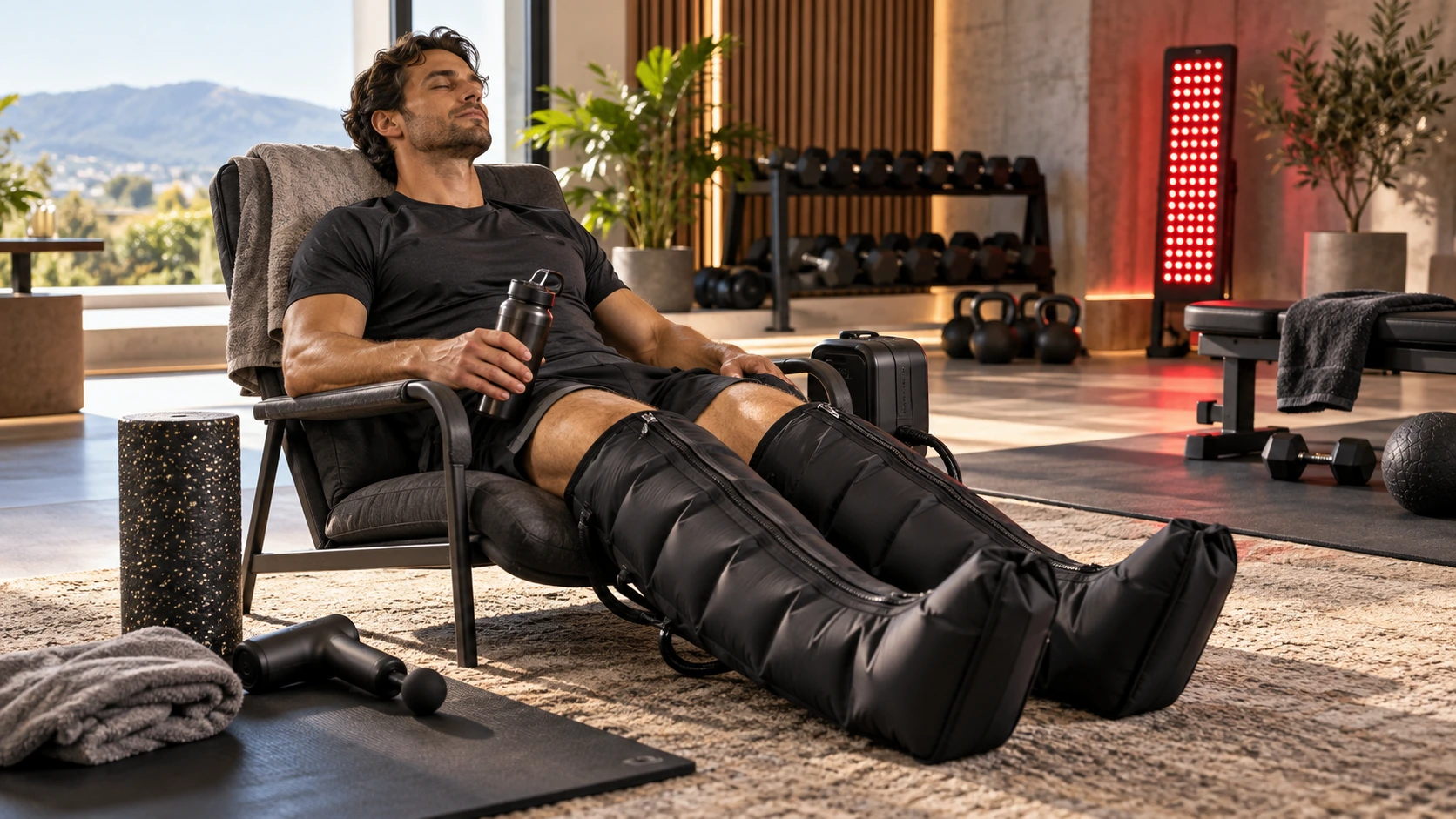
Pneumatic compression boots inflate in sequence from the foot to the hip. They were developed for medical conditions involving swelling and circulation, where they work well. In healthy athletes the evidence is less convincing. Studies show small reductions in perceived soreness for some people and little to no effect on objective measures such as strength, power or markers of muscle damage.
The likely reality is that they feel pleasant, they force you to sit still with your legs up for 20 to 30 minutes, and that alone has value. At a thousand dollars or more for a home unit, that is an expensive way to sit down. An easy walk or spin, or simply lying with your legs elevated, is free.
Verdict: a pleasant extra. Low priority unless you have money to spare or access through a gym or club.
Ice baths and cold plunges
Cold water immersion has more research behind it than most tools, and the picture is interesting. Sitting in water around 10 to 15 degrees for 10 to 15 minutes after hard exercise reliably reduces muscle soreness over the following days and can help people feel and perform better when they have to back up quickly. That makes it useful in tournaments, in pre-season with multiple sessions a day and during congested competition schedules.
There is a catch. Several studies have found that using cold water regularly straight after resistance training reduces gains in muscle size and strength over time. Inflammation after lifting is part of the signal that tells muscle to adapt, and cold appears to blunt that signal. The effect on endurance adaptations seems small or absent.
So timing and purpose matter. If your priority is building strength or muscle, avoid plunging in the hours after lifting. Save it for competition periods, or use it on separate days or in the morning well away from your gym session. If you simply enjoy it for the mental lift, that is a fine reason, just plan around your strength sessions. People with heart conditions should check with their doctor first, as cold shock places a real load on the cardiovascular system.
Verdict: useful when you need to back up quickly. Counterproductive as a daily habit after strength work.
Saunas and heat
Sauna use has some encouraging evidence. Regular post-exercise sauna sessions have been shown in small studies to improve endurance performance, probably by increasing plasma volume, and heat exposure is a recognised method of preparing for competition in hot conditions. Large observational studies from Finland link frequent sauna use with better cardiovascular health, though those cannot prove cause and effect.
Unlike cold, heat does not seem to interfere with strength adaptation. The risks are dehydration and overheating, so drink fluids, keep sessions to about 15 to 20 minutes, avoid alcohol, and get medical advice first if you have a heart condition, low blood pressure or are pregnant.
Verdict: one of the better supported options, and a pleasant one. An infrared blanket at home has far less evidence than a traditional sauna.
Foam rollers and massage balls
The humble foam roller is cheap and reasonably well studied. Rolling gives a short term improvement in flexibility without reducing performance, which makes it handy before training, and it produces a small reduction in soreness afterwards. It does not release fascia or lengthen tissue in any lasting way. As with massage guns, the change is in how the nervous system responds.
Verdict: good value. Thirty to sixty seconds per muscle group is plenty.
Red light therapy
Red and near infrared light therapy, also called photobiomodulation, is the fastest growing category and the hardest to evaluate. There are plausible mechanisms and some positive trials suggesting small benefits for muscle recovery and soreness. There are also plenty of trials showing nothing. The studies use widely different wavelengths, doses and timing, and the clinical devices tested are often quite different from consumer panels and masks sold online, which are largely unregulated in terms of what they deliver.
Verdict: not proven. If you are curious and can afford it, it is unlikely to hurt you. It should be the last thing you buy, not the first.
TENS and muscle stimulators
These get confused. A TENS machine delivers a mild electrical current through the skin to reduce pain signals. It can give short term pain relief for some people and is inexpensive and safe for most. It does not heal anything.
Electrical muscle stimulation, or EMS, makes the muscle contract. It has a legitimate role in rehabilitation, for example helping to wake up the quadriceps after knee surgery when the muscle will not fire properly. As a recovery tool for healthy athletes, the evidence is thin, and as a replacement for training it does not work. No one has built meaningful strength from a stick-on pad while watching television.
Verdict: TENS is a reasonable option for pain relief. EMS is for specific rehab under guidance. People with pacemakers or other implanted devices should avoid both unless cleared by their doctor.
Sleep trackers and wearables
Rings, watches and straps now estimate your sleep, heart rate variability and “readiness”. Used well, they can nudge better habits. Seeing in black and white that you average six hours a night, or that two drinks wreck your resting heart rate, motivates some people to change.
Their limitations are worth knowing. Wearables are reasonably good at estimating total sleep time and much less accurate at sleep stages, so do not read much into your deep sleep score. Readiness scores are built on proprietary algorithms that have not been well validated against performance or injury. And for some people tracking backfires. Worrying about sleep data can itself make sleep worse, a pattern common enough to have a name: orthosomnia.
Verdict: useful for spotting trends over weeks. Ignore the day to day noise, and if the numbers make you anxious, take it off.
What actually moves the needle
If recovery were a pyramid, gadgets would be the small triangle at the top. The base is unglamorous and mostly free.
- Sleep. It is the most powerful recovery tool there is. Seven to nine hours for adults and more for teenagers and those in heavy training. Athletes who sleep less get injured more, get sick more and perform worse.
- Nutrition. Enough total energy to match your training, protein spread across the day (roughly 1.6 to 2 grams per kilogram of body weight for people training hard), carbohydrate to refuel after demanding sessions, and fluids. Under-eating is one of the most common reasons we see people failing to recover.
- Sensible training load. Most recovery problems are programming problems. Big spikes in volume or intensity, no easy days and no lighter weeks will outrun any gadget. Plan hard and easy days, and build gradually.
- Stress management. Your body does not distinguish neatly between training stress and life stress. Heavy weeks at work or exams reduce what you can absorb in training.
- Easy movement. A walk, light spin or swim on rest days does as much for soreness as most devices.
Get these right and you have most of the benefit. Get them wrong and no boot, gun or plunge will rescue you.
How to decide if a gadget is worth it
A few questions to ask before you buy:
- Are the basics in place? If you are sleeping six hours and skipping meals, start there.
- What problem am I trying to solve? “I feel flat between weekend games” is a problem with a possible solution. “I saw it on Instagram” is not.
- Will I use it consistently? The best tool is the one that does not end up under the bed.
- Does it fit my goals? If you are chasing strength and size, daily ice baths after lifting work against you.
- Am I using it to avoid something? A gadget that masks pain so you can keep training on an injury is not recovery. Pain that keeps returning needs an assessment.
Wrap-up
If you are constantly sore, flat or picking up niggles, the answer is more likely in your program than in a product. Book in with the team at VIBE Health & Performance in Homebush or Seven Hills and we will look at your training load, recovery habits and any underlying injury, and help you put your effort where it counts.