
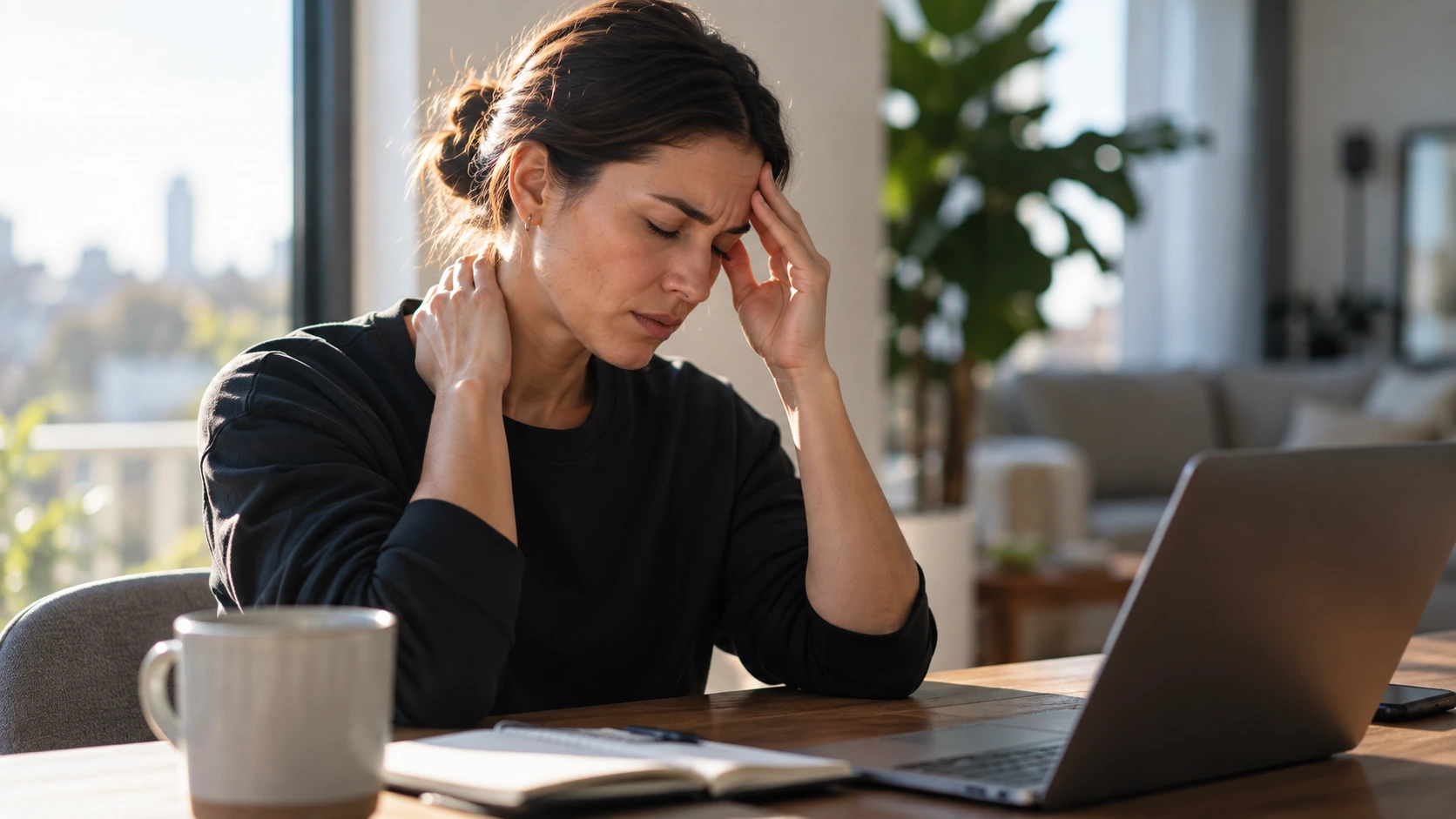
What type of headache do I have?
Tension-type headaches are usually felt on both sides as a band of pressure and are linked to stress, sleep and lifestyle factors. Cervicogenic headaches sit on one side, start in the neck, come with restricted neck movement and respond well to manual therapy and specific exercise. Migraine is a different condition again and needs medical input. The right treatment depends on working out which one you have.
Almost everyone gets headaches. For some people they are an occasional nuisance. For others they turn up several days a week and quietly shape how they work, train and sleep.
Two of the most common types we see are tension-type headache and cervicogenic headache, which is a headache that comes from the neck. They can feel similar, they are often confused with each other and with migraine, and they respond to different things. This article explains how they differ, what helps each one, and which headaches should go to a doctor rather than a physio or chiro.
Not all headaches are the same
Headaches are divided into two broad groups. Primary headaches are conditions in their own right. Tension-type headache, migraine and cluster headache sit here. Secondary headaches are caused by something else, such as a neck problem, medication overuse, a sinus infection or, rarely, something serious.
Tension-type headache is the most common primary headache in the world. Most adults will have one at some point. Cervicogenic headache is a secondary headache, because the pain is referred from the joints, discs or muscles of the upper neck.
What a tension-type headache feels like
The typical features are:
- Pain on both sides of the head, often described as a tight band, a pressing or a weight.
- Mild to moderate intensity. It is unpleasant, but most people can carry on with their day.
- A steady quality rather than throbbing.
- Not made worse by routine physical activity such as walking or climbing stairs.
- No nausea or vomiting. There may be mild sensitivity to light or to noise, but not both.
- Lasting anywhere from 30 minutes to several days.
Many people also have tenderness in the muscles of the scalp, jaw, neck and shoulders. Despite the name, the headache is not simply caused by tense muscles. Current understanding is that occasional tension-type headaches are driven largely by input from sensitive muscles and tissues around the head and neck, while the frequent and chronic forms involve the nervous system becoming more sensitive to that input over time.
Common triggers include stress, poor or irregular sleep, skipped meals, dehydration, long periods of concentration, jaw clenching and eye strain.
What a cervicogenic headache feels like
A cervicogenic headache has a different signature:
- Pain on one side of the head that stays on that side. It does not swap sides between episodes.
- It usually starts in the neck or the base of the skull and spreads forward to the temple, forehead or behind the eye.
- It is accompanied by neck pain or stiffness, and neck movement is usually restricted, especially turning.
- It is brought on or made worse by neck movements or sustained positions, such as long drives, desk work, reading in bed or sleeping awkwardly.
- Pressing on the joints or muscles of the upper neck on the painful side reproduces the familiar headache.
- The pain is a moderate, non-throbbing ache. There may be vague shoulder or arm discomfort on the same side.
Where migraine fits in
Migraine needs a mention because it is frequently mistaken for both of the above, and because people with migraine very often have neck pain. In fact, neck pain is one of the most common symptoms during a migraine attack, which leads many people to assume their neck is the cause when it is part of the migraine itself.
Migraine is typically one sided but can swap sides, throbbing, moderate to severe, and worse with physical activity. It comes with nausea, and sensitivity to both light and sound. People usually want to lie down in a dark room. Some have an aura, such as visual disturbance, beforehand. Attacks last 4 to 72 hours.
If that sounds like you, the most effective treatments are medical, and a conversation with your GP is the right first step. We can still help with neck symptoms and general factors like exercise and sleep, but we will be upfront that we are supporting your management, not leading it. Many people also have more than one headache type, which is where a careful assessment earns its keep.
Why the neck can cause head pain
It seems odd that a joint in the neck could produce pain behind the eye. The explanation lies in how the nervous system is wired.
Sensory nerves from the top three levels of the neck feed into the same relay station in the brainstem as the trigeminal nerve, which carries sensation from the face and head. Because the signals converge, the brain can misread where the input is coming from. Irritation in the upper neck joints, particularly the C1-2 and C2-3 levels, is felt as pain in the head. It is the same mechanism that makes heart pain show up in the arm.
How we tell them apart
There is no scan or blood test for either headache. The diagnosis comes from your history and a physical examination.
In the history we look at where the pain sits, whether it is always on the same side, what it feels like, how long it lasts, how often it comes, what brings it on and what comes with it.
In the examination we assess:
- Neck range of movement, looking for restriction and whether movement provokes the headache.
- The flexion-rotation test, which isolates rotation at the C1-2 level. Reduced rotation to one side on this test is one of the more reliable physical signs of cervicogenic headache.
- Palpation of the upper neck joints. Reproducing your familiar headache with pressure on a specific joint is a strong indicator.
- The strength and endurance of the deep neck muscles and the muscles around the shoulder blades, which are often reduced in people with neck related headache.
- Jaw function and muscle tenderness around the head and neck.
We also screen for the warning signs listed further down. If the pattern points to migraine or anything outside our scope, we will tell you and refer you on.
What helps a tension-type headache
For occasional tension-type headaches, simple pain relief such as paracetamol or an anti-inflammatory is effective, provided it is used only now and then. Check with your pharmacist or GP about what suits you.
For frequent headaches, the aim is to reduce how often they occur. Approaches with reasonable support include:
- Regular aerobic exercise and general strength training.
- Consistent sleep and meal times, and adequate fluids.
- Stress management. Relaxation training, cognitive behavioural therapy and biofeedback all have evidence behind them.
- Addressing jaw clenching, with input from a dentist where needed.
- Manual therapy and exercise for the neck and shoulders. The evidence here is modest. Some people get a meaningful reduction in frequency, and others notice short term relief only. We will trial it and measure it rather than promise it.
What helps a cervicogenic headache
This is where physiotherapy and chiropractic care have the strongest evidence in the headache world. A well known Australian trial compared manual therapy, a specific exercise program, the two combined and a control group in people with cervicogenic headache. Both manual therapy and exercise reduced headache frequency and intensity, and the improvements were still there a year later.
In practice, treatment includes:
- Mobilisation or manipulation of the stiff upper neck joints, chosen in consultation with you.
- A home mobility exercise for C1-2 rotation, which takes about a minute and can be very effective.
- Retraining of the deep neck flexors, the small stabilising muscles at the front of the neck, followed by strengthening of the neck and the muscles around the shoulder blades.
- Changes to the sustained positions that provoke you, which are usually more about how long you stay still than how you sit.
Most people with a true cervicogenic headache notice a change within three to four sessions. If nothing has shifted by then, we revisit the diagnosis.
What about posture, pillows and screens?
Posture gets blamed for most headaches, and the evidence does not back that up. People with a forward head position are not reliably more likely to have headaches than those without. What does seem to matter is staying in any one position for a long time. Changing position every 30 to 45 minutes and moving your neck through its range does more than holding yourself rigidly upright.
Pillows are similar. There is no single best pillow. One that keeps your neck roughly in line with your spine when you lie on your side or back, and that you find comfortable, is enough. Sleeping on your stomach with your head fully turned can aggravate an upper neck problem and is worth changing if you have cervicogenic headaches.
Medication overuse headache
This one catches many people out. Taking pain relief for headaches too often can cause more headaches. As a rough guide, the risk rises with simple painkillers such as paracetamol or ibuprofen on 15 or more days a month, or with codeine containing products or triptans on 10 or more days a month, over a period of months.
If you are reaching for tablets most days and your headaches are becoming more frequent, this may be part of the picture. Do not stop suddenly without advice. Speak with your GP, who can help you withdraw safely and look at preventive options.
Headaches that need a doctor, not a physio
Most headaches are harmless. A small number are not. Seek urgent medical attention for:
- A sudden, severe headache that peaks within a minute, often described as the worst headache of your life.
- A headache with fever, a stiff neck, a rash, confusion or drowsiness.
- A headache with weakness, numbness, slurred speech, facial droop, double vision or loss of vision.
- A headache after a head injury, particularly if it is worsening.
- Sudden, unusual neck pain and headache, especially after neck trauma, along with dizziness, unsteadiness, or trouble speaking or swallowing.
See your GP soon for:
- A new headache if you are over 50, or a clear change in your usual headache pattern.
- Headaches that are steadily getting worse over weeks.
- Headaches that wake you from sleep or are worse when lying down, coughing or straining.
- A new headache during pregnancy or if you have a history of cancer or reduced immunity.
- Scalp tenderness or jaw pain with chewing if you are over 50.
We screen for these at every first appointment and will refer you straight on if anything does not fit.
What an appointment at VIBE looks like
Your first session is mostly detective work. We will go through your headache history in detail, screen for anything that needs medical attention, and examine your neck, jaw and shoulders. By the end you should know which type, or types, of headache you are most likely dealing with and whether treatment with us is likely to help.
If your neck is involved, we will start treatment that day and give you one or two exercises to do at home. We will ask you to track headache days, intensity and medication use so we can measure progress with numbers rather than impressions. If your headaches look like migraine or something else, we will write to your GP with our findings.
If headaches are becoming a regular feature of your week, book an assessment with one of our physiotherapists or chiropractors at VIBE Health & Performance in Homebush or Seven Hills. If the neck is the source, we will treat it. If it is not, we will tell you and point you in the right direction.