
Dry Needling
What dry needling actually is
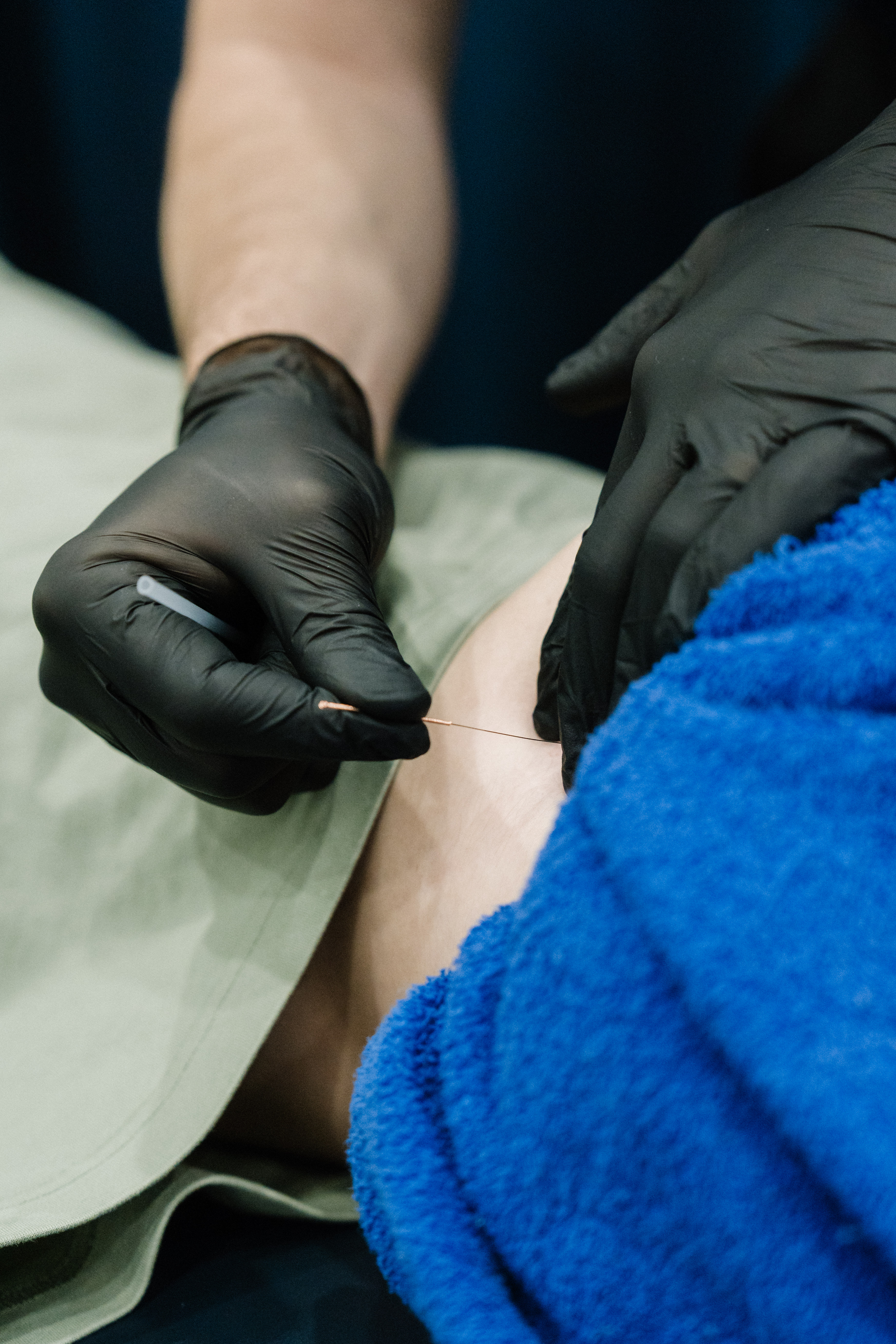
Dry needling is a treatment where we put thin, sterile needles into tight or painful muscle to help it settle down. The needles are the same kind acupuncturists use: very fine, nothing like the needle you get a vaccine with. “Dry” just means there’s nothing coming out of the needle. No injection, no medication. It’s the needle on its own.
We’re aiming for the spots in a muscle that have knotted up and won’t release, often called trigger points. When the needle reaches one, it can prompt the muscle to twitch and let go, which is what brings the tension and pain down.
The important thing to understand up front is that dry needling is a technique, not a therapy in its own right. It’s one tool we reach for when it suits the problem, and we almost always use it alongside hands-on treatment and exercise. You wouldn’t come in just for needling any more than you’d book a session of “stretching”.
Dry needling vs acupuncture: the real difference
This is the question we get most, and it’s a fair one. The needles look identical, because they basically are.
The difference is the thinking behind them. Acupuncture comes from Traditional Chinese Medicine. It works with ideas like meridians and qi, lines of energy running through the body, and needles are placed along those lines.
Dry needling comes from Western anatomy and neuroscience. We’re not working with energy lines. We’re targeting specific muscles and trigger points based on where you’re sore, how the muscle is behaving, and what we feel when we examine you. Same tool, completely different map.
Neither one is “the real version”. They’re two different traditions that happen to have landed on the same piece of equipment. If acupuncture has helped you in the past, that’s genuinely good. It’s just a different approach built on a different model of the body. When we needle, we’re doing it for anatomical reasons, not energetic ones.
What conditions dry needling helps with
Dry needling is at its best with muscle that’s tight, knotted and overactive. The kinds of things it tends to help:
- Neck and shoulder tension: the classic “I carry my stress here” knot
- Lower back tightness
- Headaches that are driven by tight muscles in the neck and the base of the skull
- Calf and hamstring tightness in runners
- Some tendon problems (tendinopathies), where the muscle around the tendon is part of the picture
And here’s the honest other half, because it matters more than the list above: dry needling is not the answer for everything.
It won’t fix a fresh, acute injury. A new muscle tear or a badly sprained ankle does not want a needle in it. It doesn’t treat joint problems, nerve compression, or anything structural like a disc issue or arthritis. If your pain is coming from the joint or the bone rather than the muscle around it, needling the muscle might take the edge off for a day, but it isn’t treating the cause.
So think of it as a muscle tool. When the problem is muscular, it’s good. When it isn’t, we’ll tell you and do something else instead.
Does dry needling hurt?
I’ll be straight with you, because “it’s completely painless” is a fib and you’ll know it the moment we start.
You’ll usually feel the needle go in. A quick, sharp prick that’s gone in a second. That part is mild.
The bigger sensation is the twitch response. When the needle finds a trigger point, the muscle can grab and twitch on its own. It feels like a deep ache or a brief cramp, a strong, dull “oof” that lasts a second or two and then eases off. It’s an odd feeling the first time, and some people find it genuinely uncomfortable.
Most patients describe it as very manageable, and a fair few say the twitch is oddly satisfying, like the muscle finally letting go of something it had been holding. A few people don’t enjoy it at all, and that’s completely fine. We can use fewer needles, go gentler, or stop altogether. Nothing about this has to be endured, so tell us what you’re feeling and we adjust.
What a dry needling session is like at VIBE
It’s quick and undramatic, which surprises some people.
We start with a short assessment: where it hurts, how it moves, which muscles are involved. Then we’ll get you comfortable lying down or sitting, clean the area, and insert the needles into the muscles we’re targeting. Depending on the muscle and the problem, we’ll either leave the needles in for a few minutes or use a quick in-and-out technique to get that twitch response.
It’s nearly always part of a bigger session rather than the whole thing. We’ll usually combine it with hands-on treatment and send you home with a couple of specific exercises to keep the progress going, because the needle settles the muscle but the exercise is what stops it tightening straight back up.
One thing worth knowing: every clinician at VIBE is GEMt-certified, which is the gold-standard training for dry needling. That’s not a brag. It matters because needling near nerves, the lungs and major muscle groups is something you want done by someone properly trained, not by someone who did a weekend course.
Yes, both can, as long as they’ve done the proper training for it. Dry needling isn’t owned by one profession. At VIBE it’s part of what our physiotherapists and chiropractors offer, because all of them have done the certified training. The qualification matters far more than the title on the door. A well-trained physio and a well-trained chiro will needle to the same standard.
How many sessions you’ll need
The honest answer is: it depends, and anyone who promises you a fixed number before they’ve assessed you is guessing.
For a simple, recent bit of muscle tightness, one or two sessions can be enough. For something chronic that’s been building for months, you’re more likely looking at four to six sessions spread over a few weeks, alongside the exercises we give you.
Here’s our actual rule, though. If dry needling isn’t doing anything after about three sessions, we stop and rethink. Either the diagnosis needs another look or the treatment needs to change. We’re not going to keep needling you week after week just because it’s on the menu. If it isn’t working, it isn’t working, and we’ll say so.
Side effects and safety
Dry needling is very safe when it’s done by someone trained properly. The common side effects are mild and short-lived:
- Soreness in the treated muscle for 24 to 48 hours, a bit like the day after a hard workout
- Occasional light bruising
- Feeling a little tired or “lose” for the rest of the day
These settle on their own. Gentle movement and staying hydrated help.
Serious problems are rare, but this is an honest article so I’ll name the main one. Needling around the chest and upper back carries a small risk to the lung if it’s done carelessly. That’s exactly why training matters and why we’re fussy about it.
There are also people and situations where we’re cautious or hold off entirely:
- Pregnancy: we avoid certain areas
- Blood thinners: bruising is more likely, so we adjust our approach
- A genuine needle phobia: if needles make you faint or panic, this isn’t the treatment for you, and that’s a perfectly reasonable position
We’ll always ask about these before we start. If something rules it out, we’ve got plenty of other tools to reach for.
Is dry needling the right treatment for you?
Here’s a simple test. Have you got muscle tightness or a knot that won’t shift no matter how much you stretch, foam-roll or massage it? That’s the situation where dry needling earns its place.
If your problem is a joint, a nerve, a fresh injury or something structural, it’s probably not the right call, and we’d rather tell you that than sell you sessions that won’t help.
The only way to know for sure is to be assessed. We’ll feel around, test how things move, and recommend needling only if it genuinely fits the problem in front of us.
Wrap-up
Dry needling is a genuinely useful tool for stubborn muscle tension. Not a miracle and not a cure-all, but effective for the right problem in trained hands.
You don’t book it on its own. You book a physiotherapy or chiropractic appointment, we assess what’s actually going on, and we’ll use dry needling if it’s the right fit, alongside the hands-on work and the exercises that make the result stick. Available at both clinics, book today to see if its for you!