
When to Replace Your Running Shoes
Most running shoes have a useful life of somewhere between 500 and 800 kilometres. After that, the foam that absorbs impact stops bouncing back, and the load it was soaking up gets passed on to your calves, shins, knees, and feet.
The tricky part is that shoes don’t fail on a schedule. A lightweight racer might be cooked at 400km. A well-built daily trainer might still be fine at 750km. And because the foam breaks down gradually, you adapt to it run by run and never notice the change.
Here’s how to work out when you are due for an upgrade.
Why 500-800km Is the Range
The midsole foam in a running shoe compresses with every foot strike, then springs back. Over hundreds of kilometers, it loses that ability to rebound. The shoe still looks fine, but it’s absorbing less and you’re absorbing more.
Where your shoes land in that 500-800km range depends on:
- Your size. A 90kg runner compresses foam faster than a 60kg runner. Heavier runners should plan for the lower end of the range.
- Shoe type. Lightweight racing shoes use softer, less durable foams and may only last 300-500km. Cushioned daily trainers last longest.
- Surface. Pavement chews through shoes faster than grass or trail.
- Running style. Heel strikers wear the rear of the shoe; forefoot runners wear the front. Either way, the foam under your strike point goes first.
5 Signs Your Shoes Are Done
1. New niggles with no change in training
This is the big one, and the one runners miss most. If your calves, shins, or knees start complaining and you haven’t changed your distance, pace, or routes, check your shoe mileage before anything else. Dead shoes are one of the most common triggers for the overload injuries we covered in the 5 most common running injuries — particularly shin splints and plantar fasciitis.
2. The midsole is wrinkled or compressed
Look at the foam from the side. Deep creases and wrinkle lines, especially under the heel, mean the foam has compressed and isn’t coming back. Press your thumb into the midsole: it should feel firm and springy. If it feels dense, like pressing into a tyre rather than a pillow, the cushioning is gone.
3. The outsole is worn smooth
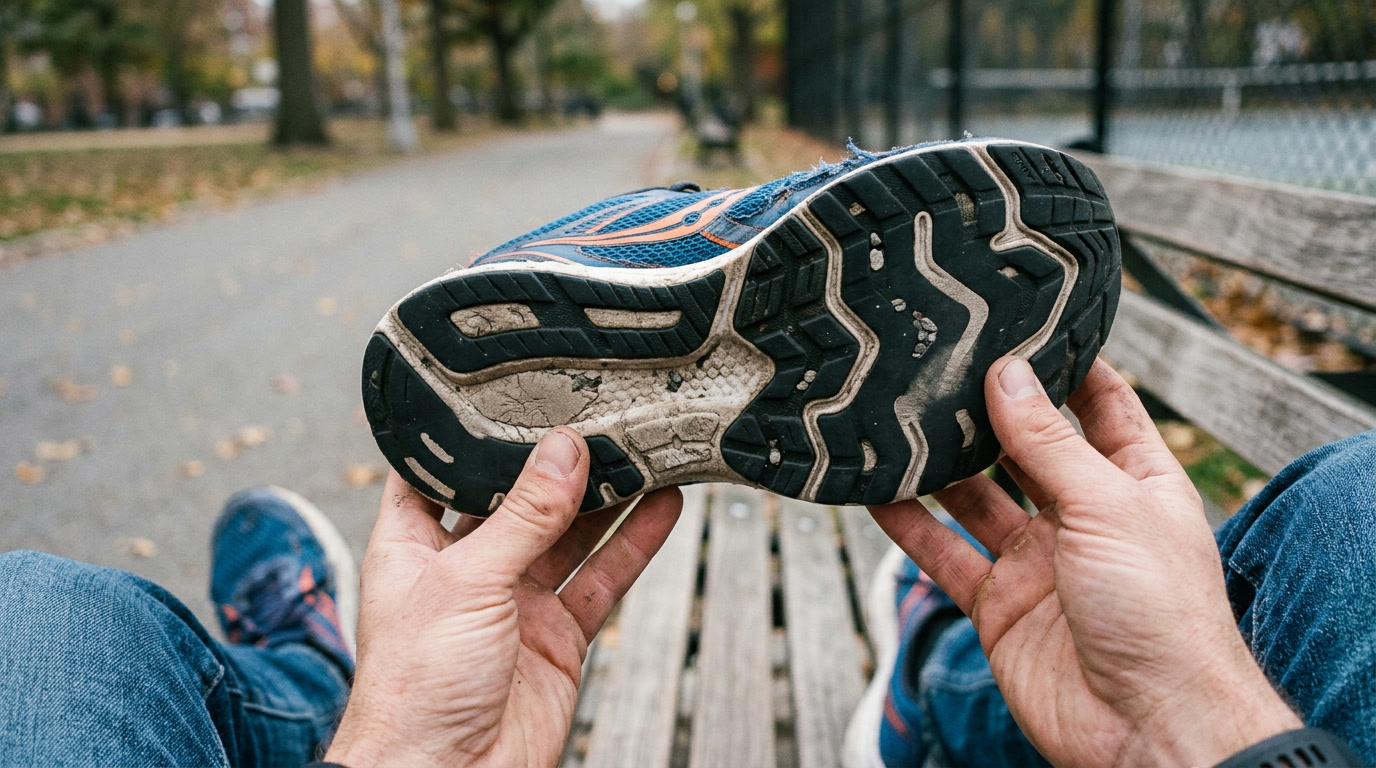
Flip the shoe over. If the rubber tread is worn flat in your strike zone, or you can see the midsole foam showing through the outsole, you’re well past the use-by date. Uneven wear (one shoe much worse than the other, or one edge worn right down) is also worth showing your physio, because it can flag a control or gait issue worth addressing.
4. The shoe leans when you put it on a flat surface
Place both shoes on a table and look at them from behind. If one tilts inward or outward instead of sitting level, the midsole has compressed unevenly. Every run in that shoe is now loading you slightly off-axis, thousands of steps at a time.
5. The new-shoe comparison test
The simplest test of all. Try on a fresh pair of the same model next to your current pair. If the difference feels dramatic, that’s how much cushioning you’ve lost without noticing. Runners do this in-store all the time and the reaction is almost always the same: “I didn’t realise how dead mine were.”
How to Actually Track Your Mileage
Nobody remembers when they bought their shoes. Take the guesswork out:
- Use your watch or app. Strava, Runna and Garmin all have a gear tracker. Add your shoes once, and every run logs against them automatically. When the total hits 500km, start paying attention.
- Write the date on them. Old-school but effective: sharpie the purchase date inside the tongue. If you run 30km a week, your shoes hit 600km in about 20 weeks, so roughly two pairs a year.
- Rotate two pairs. Foam recovers some of its bounce between runs if you give it 24-48 hours. Alternating two pairs extends the life of both, and gives you a built-in comparison: when the old pair starts feeling noticeably flatter than the newer one, it’s done.
Don’t Bin Them, Demote Them
Shoes that are dead for running are usually fine for the gym, walking the dog, or mowing the lawn. The foam can’t handle repetitive impact anymore, but it doesn’t need to for everyday wear. Demote them, and keep your fresh pair exclusively for runs so your mileage tracking stays accurate.
The Bigger Picture
New shoes fix worn-out cushioning. They don’t fix weak calves, poor hip control, or a training load that’s climbing too fast. If you’ve replaced your shoes and the niggles are still hanging around, the shoes were probably never the whole story. That’s when a proper assessment is worth your time. Our team at Homebush and Seven Hills can look at how you move, not just what’s on your feet. Book online or call 1800 4 VIBES.
FAQs
How many kilometres do running shoes last?
Most running shoes last between 500 and 800 kilometres. Lightweight racing shoes may only last 300-500km, while cushioned daily trainers sit at the higher end. Heavier runners and pavement-only runners should expect the lower end of the range.
How long do running shoes last in months?
It depends entirely on your weekly volume. At 20km a week, shoes last roughly 6 to 9 months. At 50km a week, they’re done in 10 to 16 weeks. Track kilometres, not months. A shoe app or gear tracker can do this automatically.
Can old running shoes cause injuries?
Yes. Worn-out midsole foam absorbs less impact, transferring more load to your calves, shins, knees, and feet. Dead shoes are a common contributing factor in shin splints, plantar fasciitis, and knee pain, especially when training load increases at the same time.
Is it bad to run in shoes with worn tread but good cushioning?
Tread and cushioning wear together. By the time the outsole rubber is worn smooth, the midsole foam underneath has usually compressed too. Visible midsole through the outsole, a leaning heel, or a dense feel under thumb pressure all mean the shoe is past its useful life for running.
Should I rotate two pairs of running shoes?
Yes, if you run three or more times a week. Foam partially recovers its cushioning when rested for 24-48 hours, so rotating two pairs extends the life of both. It also gives you a constant comparison point, making it obvious when the older pair has gone flat.