
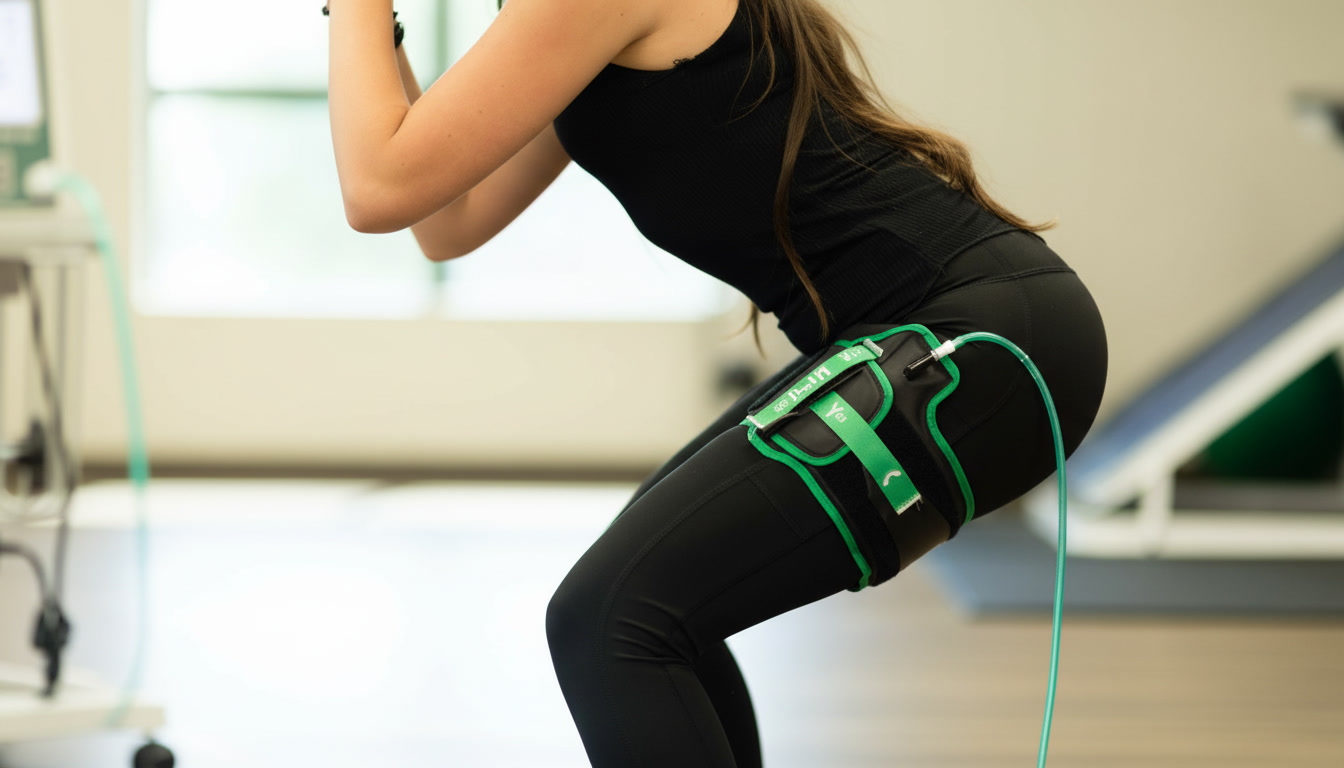
BFR Training
BFR is the clinical tool that lets you build strength when you can’t lift heavy.
What is blood flow restriction training?
Blood flow restriction (BFR) training sounds more complicated than it is.
A specialised cuff is wrapped around the top of your arm or leg, similar in concept to a blood pressure cuff, but purpose-built for exercise. The cuff is inflated to a carefully calculated pressure that partially restricts blood flow in that limb. Then you exercise using light weights or bodyweight movements.
The result is that your muscles respond as if you’re working much harder than you actually are. Strength adaptations that normally require heavy loading start happening at loads as light as 20–30% of your maximum.
For someone who just had knee surgery and can barely walk upstairs, let alone squat with a barbell, that’s a significant clinical advantage.
BFR isn’t a gym trend or a biohacking gimmick. It’s been studied extensively since the 1990s, with a large and growing body of peer-reviewed research supporting its use in rehabilitation and strength training. It’s used in elite sporting programs, military rehabilitation facilities, and post-surgical recovery contexts worldwide.
How BFR actually works
Here’s the basic physiology of BFR.
When the cuff partially restricts blood flow out of the limb (venous outflow), blood pools in the working muscle. The muscle is doing its job, but it can’t clear metabolic waste products as efficiently as usual. Oxygen delivery is also reduced.
The body interprets this as a high-effort situation. To cope with the demand, it recruits fast-twitch muscle fibres, the ones normally reserved for heavy or explosive work. It also triggers the release of hormones associated with muscle growth, including growth hormone and IGF-1.
The practical upshot: you get a physiological strength and hypertrophy response from a load that, under normal circumstances, would be far too light to produce one. Your nervous system and muscles are essentially being tricked into thinking they’re working at maximum effort, when the actual load on the joint is minimal.
This is why BFR is so well-suited to rehab. The limiting factor in post-surgical recovery is almost never effort or motivation, it’s what the healing tissue can tolerate. BFR lets you work the muscle hard while keeping the mechanical stress on the joint low.
Your muscles respond as if you’re lifting heavy — while the load on the joint stays low.
Why BFR is a game-changer for rehabilitation
There’s a big problem in post-surgical rehab: muscle atrophy happens fast, and strength comes back slowly.
After ACL reconstruction, for example, the quad can lose a significant portion of its strength in the first few weeks post-op. That’s not just pain or swelling, it’s a neurological process called arthrogenic muscle inhibition, where the joint injury literally suppresses the muscle’s ability to activate. Without targeted intervention, that strength deficit can persist for months or even years after surgery.
Traditionally, the only reliable way to drive meaningful strength gains is to load the muscle at or above roughly 60–70% of its maximum capacity. For a freshly reconstructed knee, that’s nowhere close to feasible in the early post-op period. Trust me, I’ve seen this first-hand after my own ACL surgery, my left quad had visibly wasted compared to the right.
BFR changes that equation. Research has consistently shown that BFR training at 20–30% of maximum load produces strength and muscle mass gains comparable to traditional heavy training, and in some post-surgical populations, BFR protocols have outperformed conventional rehabilitation for early strength recovery.
The applications extend beyond ACL surgery. BFR has strong evidence in:
- Post knee replacement rehabilitation
- Achilles tendon repair recovery
- Rotator cuff and shoulder surgery rehab
- Patellofemoral pain and chronic knee conditions
- Stress fracture recovery where loading must be minimised
In each example, the core benefit is the same: meaningful strength work without the joint load that would otherwise make it unsafe.
Who benefits from BFR training?
Post-surgical patients
This is where BFR gets its clinical reputation. Whether you’ve had ACL reconstruction, knee replacement, Achilles repair, or shoulder surgery, the early post-operative period involves a frustrating mismatch: you need to rebuild strength, but the healing tissue can’t tolerate the loads that normally drive that adaptation.
BFR resolves that mismatch. You can begin meaningful strength work far earlier than a conventional program would allow, reducing the extent of muscle loss and accelerating the timeline to functional recovery.
Injured athletes
For athletes managing an injury that prevents normal training (a stress fracture, a soft tissue injury, a tendon problem) maintaining strength in the affected limb is a real challenge. BFR allows targeted work on the injured area at loads the tissue can tolerate, reducing deconditioning during the period of modified training.
It also allows work on the uninjured limb with a cross-education effect: training one limb with BFR has been shown to produce some strength preservation in the untrained limb through central nervous system pathways. It’s not a substitute for direct training, but it’s a useful adjunct.
Older adults
Sarcopenia (age-related muscle loss) is one of the most significant drivers of functional decline and injury risk in older adults. The problem is that maintaining muscle mass requires sufficient loading, and heavy lifting isn’t always realistic or safe for people with osteoarthritis, joint replacements, or cardiovascular limitations.
BFR offers an alternative pathway. Studies in older adult populations have shown meaningful strength and muscle mass gains from BFR protocols, with the lower mechanical loads making it more tolerable and accessible for people who couldn’t safely manage conventional resistance training.
Persistent strength deficits and chronic conditions
Some people finish their formal rehab program but carry a residual strength deficit, maybe a limb that’s 80% of its target, not 95%. Others have chronic joint conditions like osteoarthritis where heavy loading consistently provokes flare-ups. BFR can be a useful long-term tool for building and maintaining strength in these situations, where the usual training options are off the table.
What does BFR actually feel like?
This is the question most people have and its hard to describe.
The cuff itself is firm, a fair bit tighter than a blood pressure cuff, but not painful. Most people describe a sense of fullness or pressure in the limb, particularly as the session progresses. That’s normal and expected.
The exercises feel hard very quickly. That’s the whole point. Movements that would normally feel light (a set of shallow squats, some calf raises, light bicep curls) produce a deep, intense muscle burn within a few reps. Your muscles fatigue much faster than you’d expect given the load you’re using.
Most people find BFR uncomfortable in a way that’s clearly productive, the kind of discomfort that tells you something is happening. It’s not the sharp or alarming sensation of pain. It’s more of a deep fatigue of a muscle working at its limit.
After the cuff is released, there’s often a brief reactive hyperaemia (a rush of blood back into the limb) that produces a temporary warmth and flushing sensation. It passes quickly and is completely normal.
Most patients tolerate BFR well from the first session. For those who find the sensation difficult initially, we progress gradually, starting with lower pressures and shorter durations until you feel more comfortable.
Is BFR training safe?
Yes. When it’s done correctly, with the right equipment and a trained practitioner applying it.
The key word in BFR is ‘partial’ restriction. The goal is not to cut off blood flow entirely, it’s to reduce it by a calculated amount based on your individual limb occlusion pressure. That pressure varies from person to person, which is why a proper clinical assessment matters.
At VIBE, we use medical-grade automated cuffs that measure your individual limb occlusion pressure before each session and set the restriction level accordingly. This is very different from applying a belt or elastic band and guessing.
There are genuine contraindications to BFR, and your practitioner will screen for these before starting:
- History of deep vein thrombosis (DVT) or clotting disorders
- Severe or uncontrolled hypertension
- Active infection or open wound in the affected limb
- Peripheral vascular disease
- Pregnancy
- Sickle cell trait in some populations
BFR is not appropriate for everyone, and we’re not going to apply it without first understanding your health history. The screening conversation takes a few minutes and is not optional.
For the vast majority of rehab patients without these contraindications, BFR has an excellent safety record across a large volume of published research and clinical use.
Why doing BFR at home with a cheap cuff is a bad idea
BFR cuffs are available online for as low as $30. We’d strongly recommend against buying one and trying it yourself.
The entire safety and efficacy of BFR depends on applying the correct level of partial restriction, calibrated to your individual limb occlusion pressure. Too little restriction and you get no meaningful stimulus. Too much and you’re approaching full occlusion, which carries real risks: nerve damage, tissue ischaemia, and in extreme cases, serious vascular complications.
A cheap elasticised cuff or improvised tourniquet doesn’t measure pressure. It doesn’t adjust for differences between individuals. It doesn’t account for the fact that your limb occlusion pressure changes depending on your position, blood pressure, and a dozen other variables.
There’s also the question of what you’re applying it to. BFR in the context of a post-surgical limb should be integrated into a broader rehab plan, the right exercises, the right loads, the right timing. Without that context, you’re not really doing BFR rehab. You’re just applying a tight cuff and hoping for the best.
Done properly, BFR is a powerful tool. Done improperly, the risks can outweigh the benefits. This is one worth doing right.
How we use BFR at VIBE Health
BFR isn’t something we bolt onto the end of a session as an afterthought. It’s a tool that our physiotherapists and exercise physiologists integrate into a wider rehab program at the points where it adds the most value where it’s applicable.
In ACL rehabilitation, that’s typically the early post-operative phase, where quad inhibition is at its worst and conventional loading isn’t yet possible. BFR helps us close the strength gap faster, which has a direct effect on how quickly the overall program can progress.
In post-surgical knee and lower limb rehab more broadly, we use BFR as a bridge, maintaining strength during the weeks when joint protection constraints limit what conventional training can achieve.
For athletes managing ongoing injuries or persistent deficits, BFR forms part of a targeted strength program designed by our exercise physiologists, alongside conventional resistance work and sport-specific conditioning.
The equipment we use is medical-grade. Pressures are set individually based on measured limb occlusion pressure. Sessions are guided. And BFR is always one component of a wider plan, not the whole thing.
Want to know if BFR is right for your rehab?
If you’re currently in rehabilitation (post-surgery, managing an injury, or working through a persistent strength deficit) BFR may be worth adding to your program. It’s not a magic solution, but for the right clinical scenario, it’s one of the most evidence based tools available for building strength when conventional loading isn’t an option.
Ask about BFR at your next appointment, or book a consult with our team at VIBE Health in Homebush or Seven Hills. We’ll assess whether it’s appropriate for your situation and, if so, how it fits into your broader recovery plan.
Frequently Asked Questions
What is blood flow restriction (BFR) training?
A specialised cuff is wrapped around the top of your arm or leg and inflated to a calculated pressure that partially restricts blood flow. You then exercise using light weights, and your muscles respond as if you’re working much harder than you actually are. It lets you build strength at loads as light as 20 to 30 percent of your maximum, which is a real advantage when a joint can’t yet tolerate heavy lifting.
Is BFR training safe?
Yes, when it’s done correctly with the right equipment and a trained practitioner. The key word is partial restriction. The goal is to reduce blood flow by a calculated amount, not cut it off. There are genuine contraindications (a history of DVT, clotting disorders, uncontrolled hypertension and others), so a proper screening conversation happens before anyone starts. It’s quick, and it’s not optional.
What does BFR feel like?
The cuff is firm, a bit tighter than a blood pressure cuff, but not painful. The exercises feel hard very quickly, producing a deep muscle burn within a few reps even at light loads. Most people describe it as discomfort that’s clearly productive rather than the sharp sensation of pain. After the cuff is released there’s often a brief warm, flushing feeling as blood returns, which passes quickly.
Can I do BFR at home with a cheap cuff?
We’d strongly recommend against it. The safety and the benefit both depend on applying a precise level of partial restriction calibrated to your individual limb occlusion pressure, which a cheap elasticised cuff can’t measure or adjust for. Too much restriction approaches full occlusion, which carries real risks. Done properly it’s a powerful tool; done improperly the risks start to outweigh the benefits.
Who benefits from BFR training?
Post-surgical patients (ACL, knee replacement, Achilles repair, shoulder surgery), injured athletes maintaining strength during modified training, older adults managing age-related muscle loss, and people with persistent strength deficits or chronic joint conditions where heavy loading isn’t an option. In each case the benefit is the same: meaningful strength work without the joint load that would otherwise make it unsafe.